- Adam Liberadzki
- Read in 4 min.
Artificial intelligence is no longer a future concept in banking. It’s actively reshaping how financial institutions operate. While predictive analytics and chatbots have become commonplace, Camunda AI Agents represent the next evolutionary leap: autonomous, intelligent systems that don’t just respond to queries but actively orchestrate complex, multi-step banking processes with precision and accountability.
These go far beyond simple chatbots or scripted automation, offering a transformative way to improve efficiency, compliance, and customer experience.
What Are Camunda AI Agents?
Camunda AI Agents are intelligent, autonomous components built on large language models (LLMs) that integrate directly into business process workflows and can:
- Perceive and interpret complex, unstructured information (documents, conversations, system states)
- Contextual decision-making: Interpreting complex scenarios and making informed choices based on business rules and real-time data
- Take actions using tools, APIs, or system integrations
- Adapt its approach when encountering obstacles or changing conditions.
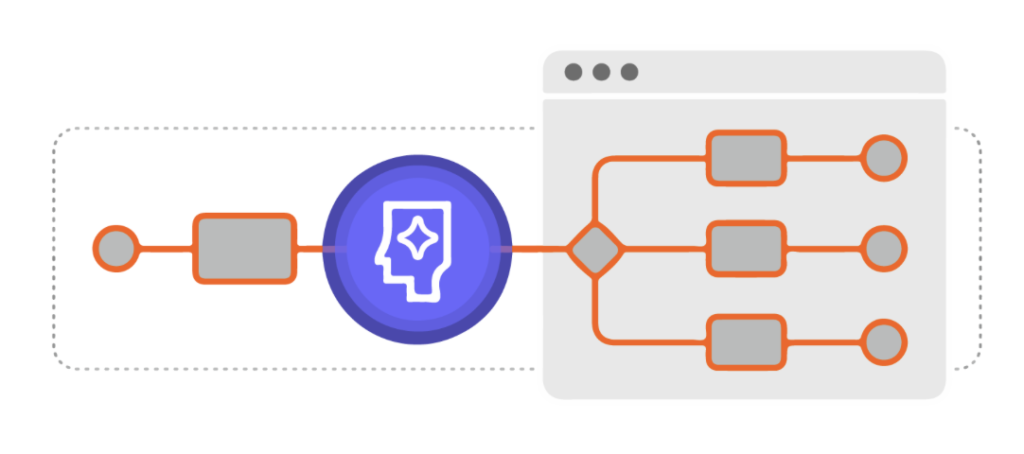
Think of an AI Agent as a digital worker that can understand instructions, reason through problems, use various tools, and complete multi-step tasks with some degree of independence.
However, a single agent operating alone has limitations: it struggles with complex multi-system workflows, and provides limited auditability. That’s where Agentic AI Orchestration comes in.
What is Agentic AI Orchestration?
Agentic AI Orchestration is the integration of AI Agents within structured business process workflows, specifically using standards like BPMN (Business Process Model and Notation). This is Camunda’s distinctive approach.
Rather than letting agents operate independently, agentic orchestration:
- Embeds agents within defined process flows where they handle specific tasks or decision points
- Combines deterministic process logic (the required steps, compliance checks, approval gates) with AI flexibility (how to interpret data, which tools to use, how to handle variations)
- Maintains human oversight through clearly defined escalation points and approval requirements
- Ensures full auditability by logging all agent actions within the process instance
- Coordinates multiple agents and systems to accomplish complex, end-to-end business outcomes
The orchestration layer acts as the “conductor” that ensures AI Agents work in harmony with human workers, business rules, and regulatory requirements—preventing the chaos of uncontrolled autonomous systems while capturing the value of intelligent automation.

Why Banking Needs AI Agents?
Financial institutions face unique operational challenges that make Camunda AI Agents particularly valuable within:
Complexity at Scale
Banks manage intricate ecosystems involving legacy mainframes, modern cloud services, parallel processing systems, and countless compliance checkpoints. Traditional rule-based automation like RPA handles repetitive tasks well but fails when confronted with unstructured data, context-dependent decisions, or exception handling.
Regulatory Imperatives
Every action in banking must be traceable, explainable, and compliant. Camunda’s process orchestration framework provides the audit trails and transparency regulators demand while allowing AI to operate within defined guardrails.
Data-Rich Environments
From transaction histories to customer communications, banks generate massive volumes of structured and unstructured data. AI Agents excel at synthesizing this information to support complex decision-making that would overwhelm manual processes.
Some Cases Where Camunda AI Agents Fit In
Below are practical examples where banks and financial institutions are applying AI Agents with measurable impact:

KYC and Customer Onboarding
Know Your Customer (KYC) processes involve document verification, data extraction, identity validation, and risk assessment across multiple systems. Camunda AI Agents can:
- Extract information from unstructured documents (passports, utility bills, bank statements)
- Validate data against external registries and sanctions lists
- Orchestrate reviews across compliance teams
- Escalate edge cases to human analysts with full context
Early adopters report onboarding time reductions of up to 70% while maintaining (and often improving) compliance standards through consistent application of rules and complete audit trails.
Credit Risk Assessment
Credit decisioning requires synthesizing data from credit bureaus, transaction histories, alternative data sources, and internal risk models. Camunda AI Agents can:
- Gather information from disparate systems
- Apply complex risk scoring logic
- Generate preliminary recommendations
- Route applications through appropriate approval workflows based on risk tiers
The orchestration layer ensures that human credit officers remain in control of final decisions while AI handles data aggregation, preliminary analysis, and routing—improving both speed and consistency.
Fraud Detection and Investigation
When suspicious activity is detected, Camunda AI Agents can orchestrate investigation workflows:
- Analyzing transaction patterns across accounts
- Gathering supporting documentation
- Coordinating with multiple fraud prevention systems
- Managing case escalation and resolution tracking
The combination of AI’s pattern recognition capabilities with Camunda’s process management ensures investigations are thorough, consistent, and fully documented for regulatory purposes.
Getting Started with Camunda AI Agents
Organizations exploring Camunda AI Agents should:
- Assess process maturity: Identify processes already modeled in BPMN or candidates for process modeling
- Evaluate use cases: Prioritize areas with high manual effort, unstructured data handling, or frequent exceptions
- Review technical requirements: Ensure connectivity to necessary banking systems and LLM infrastructure
- Engage stakeholders: Include risk, compliance, IT, and business units in planning to address concerns early
- Start with a pilot: Choose a bounded use case with clear success metrics and manageable scope
Devapo provides comprehensive technical support, and consulting services to guide organizations through implementation. As a 6 years partner of Camunda we’ve completed multiple projects on implementing Camunda into enterprises.
Additionally we have strong hands-on experience with Banking Industry
Download E-book
Camunda in Banking

Looking for more practical guidance on process automation in banking?
This ebook is based on our experience implementing Camunda in financial institutions. It is not a technical document or a collection of architecture diagrams.
Inside:
- Understanding the fundamentals of BPM
- Three key banking process scenarios to adapt:
- Customer onboarding
- Loan processing
- Card management
- Organizational models for process automation
- Implementation roadmap
Summary
Camunda AI Agents deliver on the promise of intelligent automation in banking by combining the reasoning capabilities of large language models with the governance, auditability, and reliability of business process orchestration. Unlike standalone AI tools that operate in isolation, Camunda’s agentic orchestration approach integrates AI deeply into mission-critical workflows—ensuring autonomy operates within appropriate boundaries.
For financial institutions navigating the tension between innovation and risk management, Camunda AI Agents offer a path forward: meaningful automation gains without sacrificing the control, transparency, and compliance that banking demands. As the technology matures and adoption grows, agentic orchestration will become not just a competitive advantage but a fundamental requirement for modern financial services.
Are you interested in Camunda?
Let us walk you through your options